Examining How Curated Player Insights Reshape Incentive Timing Across Wireless Entertainment Networks

Wireless entertainment networks now rely on curated player insights to adjust when and how incentives appear during mobile sessions, and this shift draws from aggregated behavioral data collected across devices and regions. Operators compile profiles that track session length, game selection patterns, and response rates to prior offers, then feed those details into timing algorithms that decide the precise moment a bonus activates. In July 2026 several major platforms reported updated deployment schedules that aligned incentive windows more closely with peak engagement periods identified through these datasets.
Building Curated Player Profiles from Wireless Data Streams
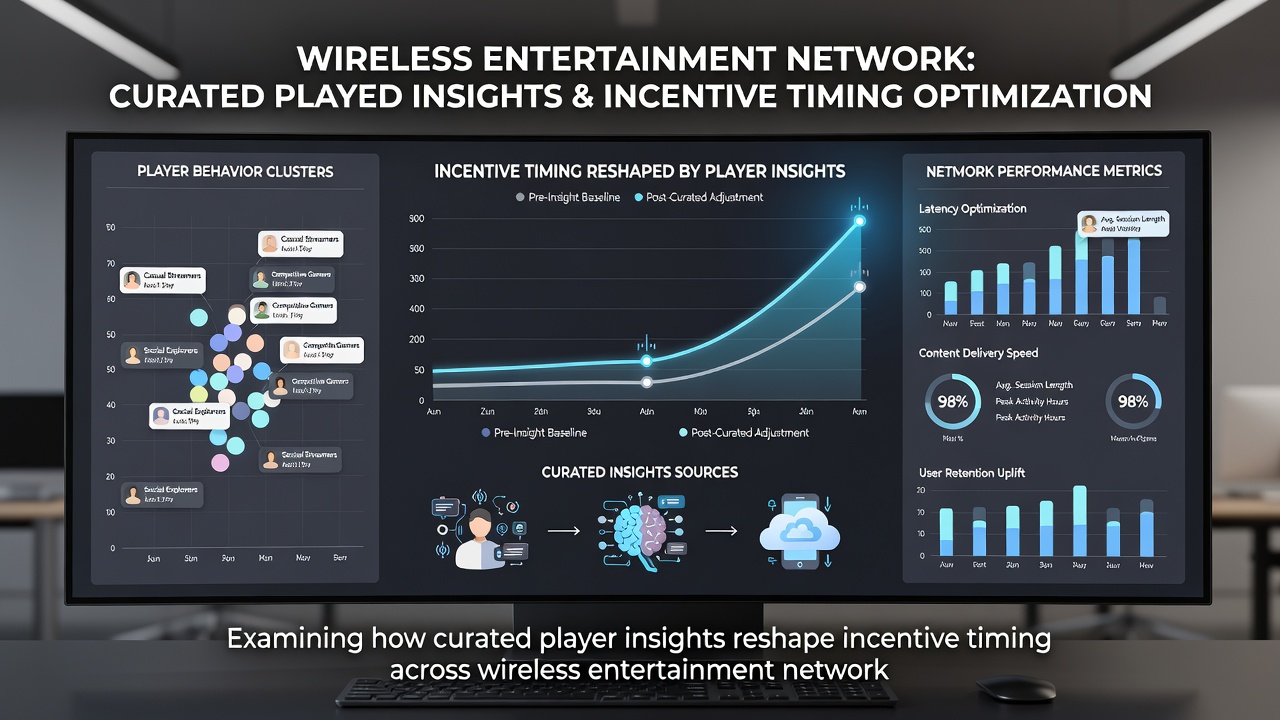
Curated insights begin with raw telemetry gathered from handheld devices on cellular and Wi-Fi connections, where systems record not only play duration but also navigation paths between different game types and funding methods. Analysts segment these records into clusters that reveal habitual timing preferences, such as users who respond better to offers delivered after twenty minutes of continuous play versus those who engage immediately upon login. Research indicates that networks processing these clusters achieve measurable changes in redemption rates when the same incentive appears at the cluster-specific moment rather than at a fixed schedule.
Wireless Network Architecture and Real-Time Decision Points
Modern wireless infrastructures support low-latency data exchange between player devices and central analytics engines, allowing incentive decisions to occur within milliseconds of a detected behavior signal. Edge computing nodes positioned near regional gateways reduce transmission delays, which matters when an algorithm must evaluate whether a user has completed a required number of spins before releasing a progressive multiplier. Figures from industry reports show that platforms using edge-processed insights reduced average decision latency by nearly forty percent compared with centralized models that existed before 2025.
Adjustments in Incentive Timing Based on Insight Clusters
Timing adjustments appear in several operational areas. Progressive jackpot contributions may accelerate only after an insight model confirms the player belongs to a segment that historically continues past the thirty-minute mark, while welcome bonuses shift to appear during the first three minutes for segments that show rapid drop-off otherwise. Observers note that cross-border platforms apply different timing rules depending on the dominant network carrier in each territory, because latency and session stability vary enough to alter engagement curves. Data released in mid-2026 by the Nevada Gaming Control Board documented a measurable rise in session extension metrics after operators implemented these segmented timing rules.
One documented example involves a North American operator that repositioned daily login rewards to occur at the exact point where player telemetry indicated the highest probability of continued play, rather than at midnight server time. The change produced a documented increase in daily active minutes without altering the reward value itself. Similar repositioning occurred in Asian markets where afternoon commute windows replaced evening leisure periods as the primary trigger point after local network data revealed higher retention during those hours.
Regulatory and Technical Considerations in Multiple Jurisdictions
Regulatory bodies across different regions have begun requesting documentation on how timing decisions derive from player data, with emphasis on transparency and auditability of the underlying algorithms. The Australian Communications and Media Authority issued updated compliance guidance in early 2026 that requires operators to maintain logs showing the data inputs used for each incentive activation window. Canadian provincial regulators followed with similar requests focused on cross-device consistency, noting that players switching between tablets and phones should experience timing continuity when the same insight profile governs both sessions.
Technical standards developed by the European Gaming and Betting Association address data segmentation practices that prevent over-personalization while still allowing timing refinements. These standards emphasize that incentive triggers must remain reversible and that players retain the option to receive offers at default times if they opt out of insight-based adjustments. Compliance reports indicate that networks adopting these standards maintained stable player satisfaction scores during the transition period in the first half of 2026.
Integration with Funding and Device Pathways
Incentive timing also intersects with funding channel data, where insight models identify whether a player typically deposits through e-wallets or direct carrier billing and adjust offer windows accordingly. Platforms report that users who complete deposits via carrier billing show stronger retention when incentives appear within ninety seconds of transaction confirmation, whereas e-wallet users respond more favorably to offers presented after game selection rather than immediately after funding. These correlations emerge from longitudinal datasets that span multiple device types and network conditions, allowing operators to refine timing without changing the incentive amount or type.
Conclusion
Curated player insights continue to influence incentive timing across wireless entertainment networks by supplying the behavioral granularity needed for precise activation windows. Regulatory frameworks in multiple jurisdictions now require documentation of these processes, while technical standards support consistent application across devices and borders. Data collected through July 2026 demonstrates that timing adjustments derived from segmented profiles produce measurable shifts in engagement metrics without altering reward structures themselves. As wireless infrastructure evolves, the linkage between curated data and incentive delivery timing will likely expand into additional operational domains.